Seven Pieces of the Ocean That Never Left American Closets
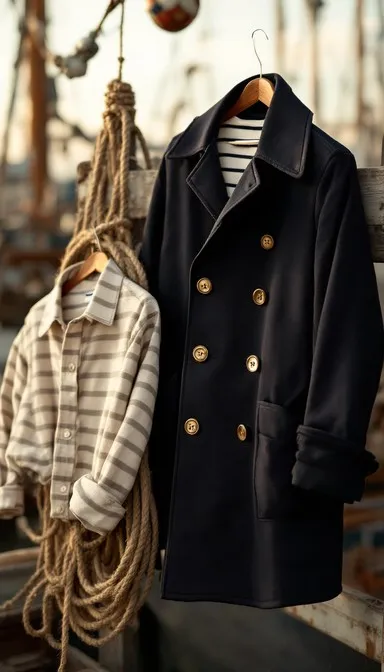
Photo: vintage nautical menswear pea coat breton stripe shirt wooden dock, via images.stockcake.com
Fashion is supposed to forget. Every season buries last season, and most garments get maybe five years of relevance before the thrift store calls. Then there are the exceptions — the pieces that came off working boats, walked onto American docks, and simply never left.
What follows is a short list of garments that have been declared dead roughly every eight years since Eisenhower was in office, and have outlived every declaration. There's a reason U Marine Blue exists: these things work.
1. The Pea Coat
Origin: Dutch sailors wore a coat called the pijjakker — literally "coat of coarse wool" — as early as the 1500s. The U.S. Navy adopted its version in the 19th century, and by WWII it was standard issue for deck hands braving Atlantic spray.
Why it stuck: Double-breasted construction, dense melton wool, and anchor-stamped buttons built to survive salt, wind, and indifference. Few garments are that over-engineered for civilian life.
Buy it today: Get real wool — 70% minimum, ideally 100% melton — and a length that hits mid-hip. Skip the $89 fast-fashion versions; they pill in one winter.
Modern move: Throw it over a hoodie and raw denim. The military-meets-street contrast is why it keeps resurfacing.
2. The Boat Shoe
Origin: In 1935, Paul Sperry slipped on his own boat's wet deck, looked at his cocker spaniel's grip on ice, and carved siping into a leather sole. The Top-Sider was born in New Haven, Connecticut.
Why it stuck: Function became a look. The moccasin construction and 360-degree lacing signaled I own a boat whether or not you did.
Buy it today: Leather uppers, genuine siped soles, and a broken-in feel from day one. The preppy versions in tan or navy dominate; the loud ones age badly.
Modern move: Worn sockless with shorts it reads 2011. Worn with cuffed selvedge denim and a striped tee, it reads timeless. Context is everything.
3. The Cable Knit Sweater
Origin: Irish Aran Islands, where fishermen's wives knitted cables said to symbolize ropes and safety for men at sea. American college students imported the look in the mid-century and never gave it back.
Why it stuck: It's the warmest thing you can wear that still looks friendly. Every Ivy League yearbook from 1958 to 1985 confirms it.
Buy it today: Lambswool or merino, natural cream or navy, with actual hand-framed cable work if you can find it. Machine-knit imitations flatten the whole appeal.
Modern move: Layer it under a chore jacket. The texture-on-texture combo is the easiest sophistication in menswear.
4. The Breton Stripe Shirt
Origin: The French Navy's 1858 uniform knit — 21 stripes, one for each of Napoleon's victories — crossed the Atlantic via American expats and Picasso, then went full mainstream when James Dean and Elvis wore one.
Why it stuck: It's a pattern that behaves like a solid. Stripes that graphic go with everything.
Buy it today: Heavyweight cotton, boat neckline, stripes wide enough to see from across a room. Thin, stretchy versions miss the point entirely.
Modern move: Under a navy blazer for the coastal look, or under olive field jacket when you want the contrast to do the work.
5. The Nautical Watch (and Its Canvas Strap)
Origin: Deck watches were designed to be legible in spray and sunlight — big numerals, high contrast, luminous hands. The NATO strap arrived in 1953 via British military spec, but America adopted it like it invented it.
Why it stuck: It's the cheapest way to make any watch look adventurous.
Buy it today: A simple dial with strong contrast, plus a navy or striped NATO strap. Under $200 gets you something genuinely good.
Modern move: Swap the bracelet for a navy NATO. Instant character, zero effort.
6. The Deck Pant / Wide-Leg Trouser
Origin: Naval-issue wide trousers — high-waisted, button-fly, built to roll up when scrubbing decks. Sailors brought them ashore, and 1930s California college kids turned them into a casualwear statement.
Why it stuck: Comfort that photographs well. The wide leg is having its third American moment and nobody's surprised.
Buy it today: High rise, wide through the thigh, in cotton twill or khaki. Navy versions double as dress pants — a two-for-one most men miss.
Modern move: Full length, no break, with a striped tee and boat shoes. The 1950s called; it was right.
7. The Sailcloth and Canvas Bag
Origin: Repurposed sailcloth and naval duffels became carryalls for a reason: the material was free, waterproof, and nearly indestructible. L.L. Bean and the sea bag tradition made it Americana.
Why it stuck: It gets better wrecked. Salt stains and frayed edges are the point.
Buy it today: Actual recycled sailcloth or heavy canvas with rope handles. If it looks pristine, it's the wrong one.
Modern move: Use it as a weekender. It outlasts whatever trendy duffel you were considering.
Why the Water Always Wins
Every one of these pieces shares a DNA: it was designed for someone whose life depended on it working. That's a design brief no trend cycle can improve on, which is why the ocean keeps lending fashion its wardrobe — and why, every few years, we all buy the same seven things again. Some of us just never stopped.