The Fade Is the Flex: A Case for Letting Your Navy Clothes Earn Their Stripes
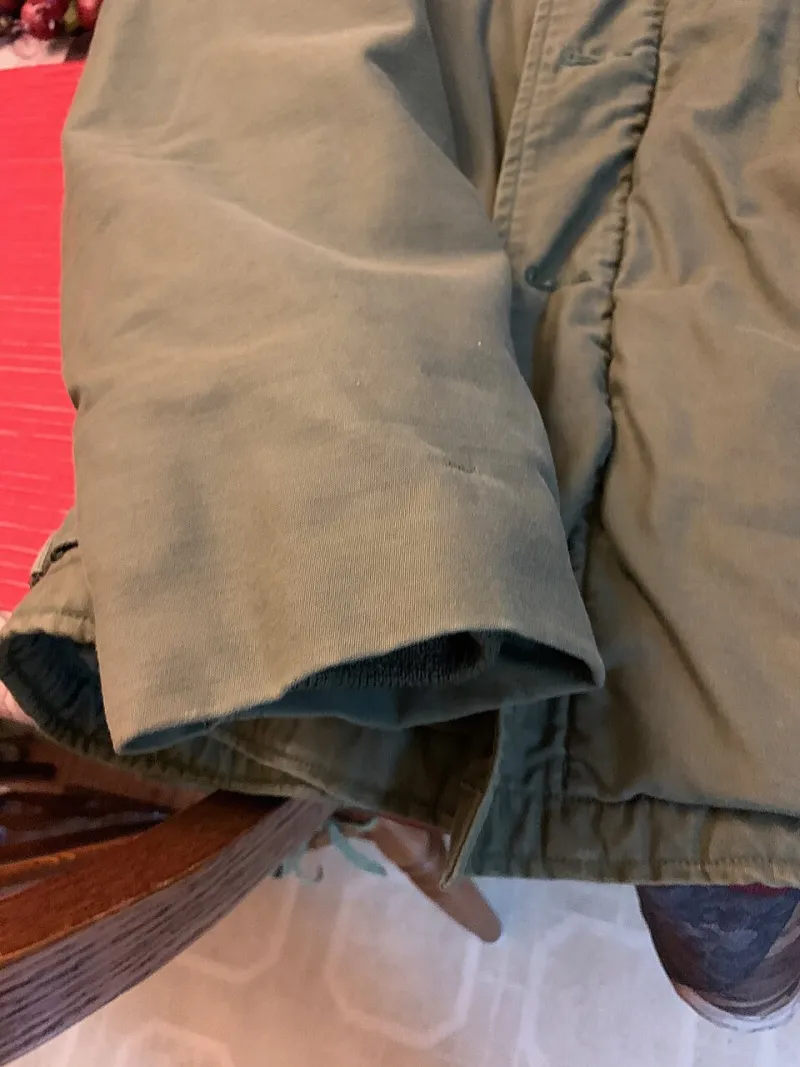
Photo: ArmyParatrooper436, CC BY-SA 4.0, via Wikimedia Commons
There's a moment every owner of a good navy piece knows. You pull the jacket off the hook, third summer of ownership, and notice the shoulders have gone from midnight to something softer — a dusty, almost stormy blue that no Pantone book bothered to name. That's not damage. That's data.
Patina Is Proof of Life
"You can't fake hours," says Dana Whitfield, who's run a vintage counter in a Rhode Island boatyard for eleven years. "I can spot a factory-distressed deck jacket from across the room. The distressing is in the wrong places. Real wear shows up where your body actually touches the garment — elbows, cuffs, the shoulder seam where a duffel bag rides."
Whitfield's inventory tells the story: 1940s Navy foul-weather parkas gone the color of a hazy horizon, canvas duffels with handles worn to a shine, chambray work shirts so faded they read almost gray. Collectors pay triple retail for these. Not despite the wear — because of it.
The logic is simple. Patina is the one design element that can't be counterfeited at scale, because it's produced by a specific life. A sun fade on a left shoulder says I carried a tackle box on that side for years. No laser machine can manufacture that biography.
What Wear Actually Does to Navy
Navy is uniquely suited to aging well. Indigo and its cousins don't fade uniformly — they break along fold lines and friction points, creating topography. Deep blue cotton duck stiffened by salt spray develops a hand-feel that new fabric spends fortunes trying to imitate. Even rope details, the brass-and-line touches we love around here, mellow: three-strand nylon goes soft and pale, brass hardware loses its mirror shine and picks up a warm, honeyed tarnish.
Coastal lifers know this intuitively. Ask anyone who's worked the water in Maine or the Outer Banks and they'll tell you the newest person on the boat is the one in pristine gear.
How to Earn the Fade (the Honest Way)
Want the patina without the decade? Here's the accelerated path — and it involves actual wear, not a washing machine trick.
- Wear it wet. Salt water, then sun. Rinse lightly, dry outside, repeat. The cycle is what breaks down fibers unevenly, which is exactly what you want.
- Carry things. Bag straps, tool rolls, a thermos in the jacket pocket. Friction is the artist; you're just booking the studio time.
- Skip the softener, always. Softener coats fibers and evens out the fade. You want contrast between worn and unworn areas.
- Line dry in direct sun, inside out sometimes, right side out other times. Inconsistency is the point.
- For rope and canvas accents: a dunk in weak salt solution, dried hard in the sun, gives you that stiffened, beachcombed texture in about three cycles.
What Not to Do
Don't buy pre-faded and call it done — that's a rental, not a story. Don't bleach. Bleach takes navy to an ugly purple-gray that reads as a mistake, not a memory. And don't over-wash; most of what makes coastal clothes look lived-in is actually what happens between washes.
The goal isn't a destroyed garment. It's a document. Every salt ring and sun line is a receipt from a day you actually lived. New clothes make claims. Old clothes make testimony. Around here, we'll take the testimony.